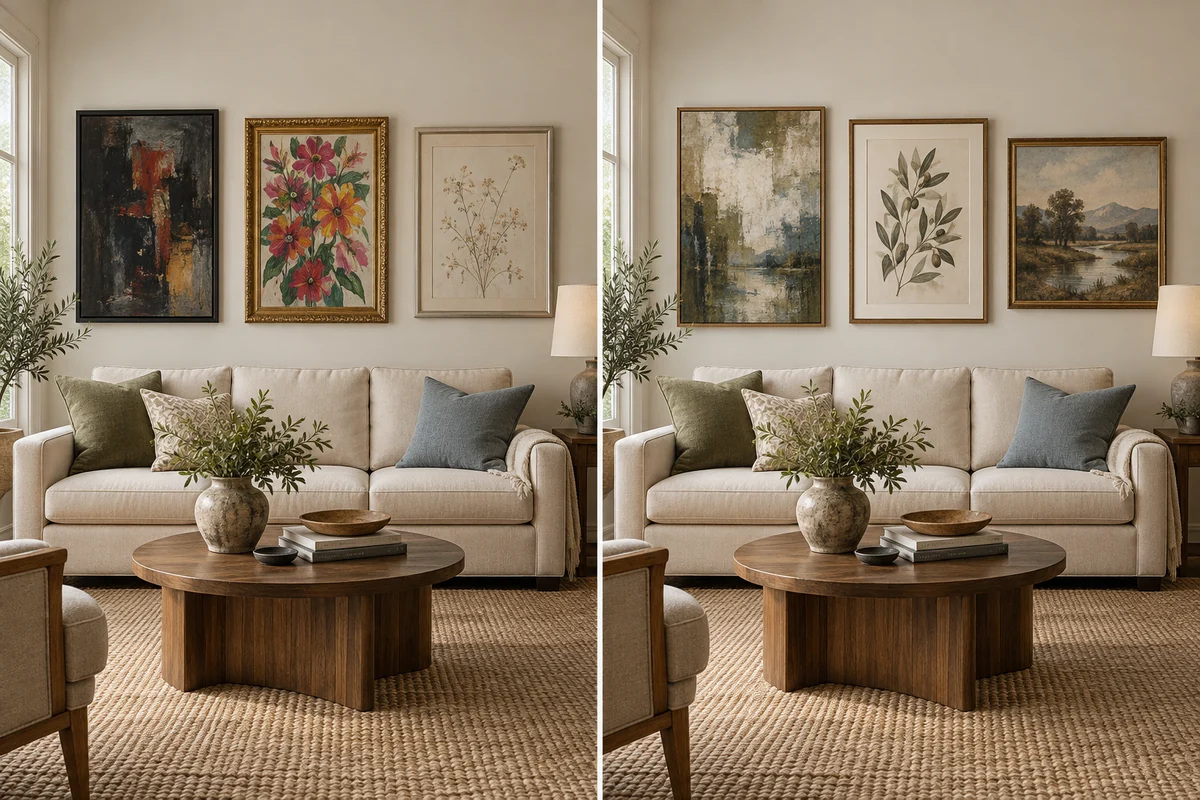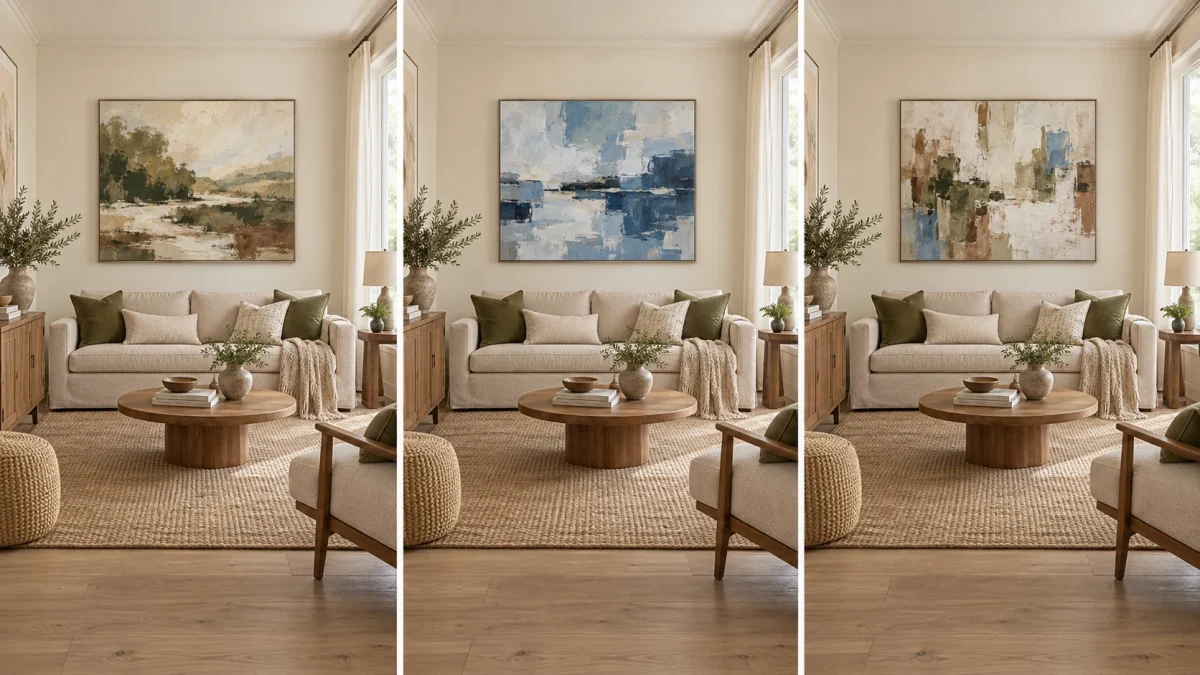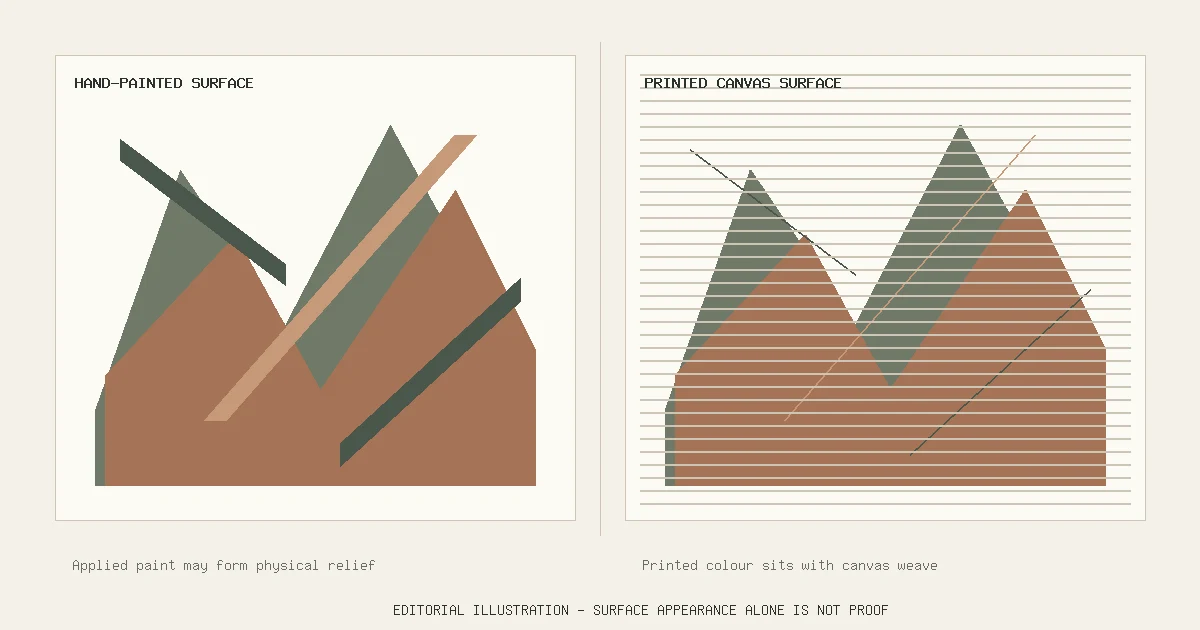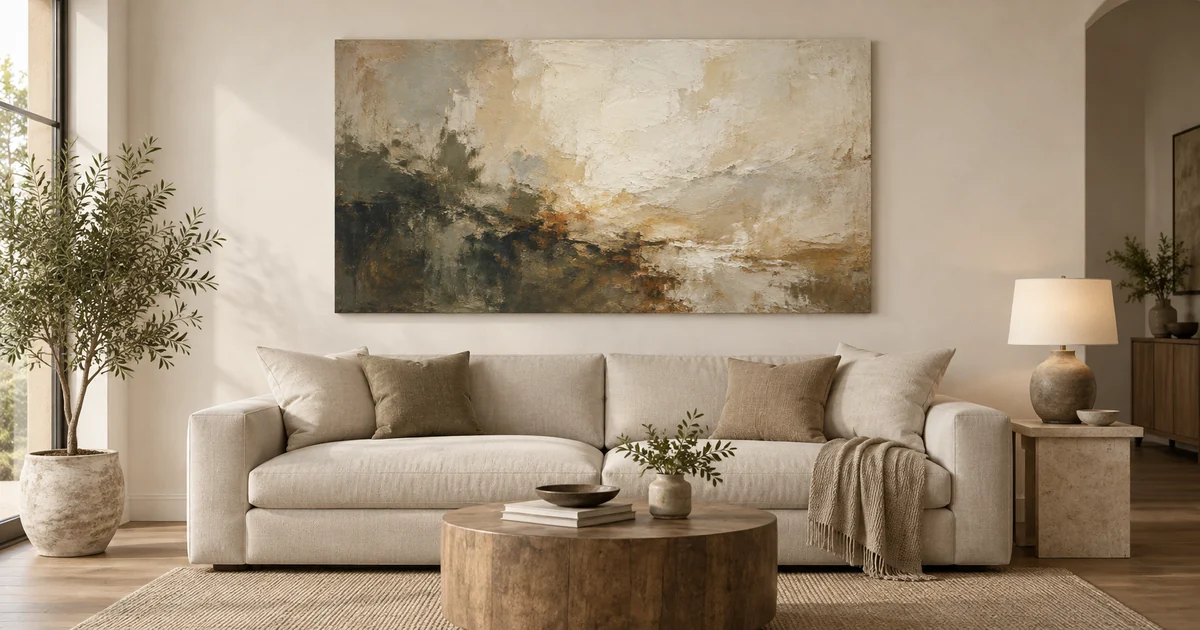
Start with the space, not the painting. Measure the part of the wall the artwork will actually occupy and, when relevant, the sofa, bed, console, or sideboard below it. For an open wall, roughly 60%–75% of the usable width is a useful starting range. Above furniture, begin around two-thirds to three-quarters of its width. Published artwork-sizing guides use similar proportions, although the exact recommendation varies with the wall, furniture, and room layout.
Then check the wall shape, nearby architecture, painting orientation, surrounding negative space, and whether a frame increases the finished outer dimensions.
How This Guide Was Prepared
This guide combines published artwork-sizing guidance with current size and format information from paintings available through Room Oil Painting. The percentage ranges are practical references, not installation rules. Before publication, the four examples below were checked against their current Room Oil Painting product listings for product name, published status, URL, orientation, available sizes, and frame choices. All conversions use 1 inch = 2.54 cm. When framing, furniture, architecture, or orientation changes the result, the guide explains the exception rather than forcing every room into one formula. The aim is to connect a measured wall to a real size option while leaving the final decision to the buyer’s room and full-scale wall preview.
Quick Answer: Measure Width First, Then Check Shape and Frame
- Measure the usable wall area rather than only the full wall.
- If the painting will sit above furniture, measure the furniture from edge to edge.
- For an open wall, use roughly 60%–75% of the usable width as an initial reference.
- Above furniture, begin around two-thirds to three-quarters of the furniture width.
- Choose a square, portrait, or landscape format that follows the shape of the available wall space.
- Check whether the product dimensions describe the canvas or the finished framed artwork.
- Preview the dimensions on the wall before ordering.
Design note: The percentages in this guide are not universal design laws. They are starting points. Ceiling height, windows, furniture, frame width, visual weight, and intentional negative space can all justify a different size.
Measure the Visual Wall Zone, Not Just the Wall
A tape measure can tell you the physical width of a wall, but that number does not always describe the space that visually belongs to the painting.
A doorway may interrupt one side. Curtains can occupy another. Wall sconces, built-in shelving, floor lamps, tall plants, cabinets, molding, or an adjacent window can all reduce the area in which artwork will look visually comfortable.
Think of this clear area as the visual wall zone. It is the rectangle of wall that the painting can occupy without competing with surrounding objects or architectural features.
Total wall width and usable wall width are different measurements
Suppose a wall measures 90 inches (229 cm) from corner to corner. A floor lamp occupies one side and a doorway visually cuts into the other. The clear wall zone between them may be only 72 inches (183 cm) wide.
For sizing artwork, the 72-inch measurement is usually more useful than the full 90 inches.
If you use 60%–75% of that 72-inch usable span as a planning range, you arrive at approximately 43–54 inches (109–137 cm) of artwork width.
Measure height separately
Width is only half of the decision. A painting can fit horizontally and still be too tall for the available wall area.
Measure from the lower visual boundary—such as a sofa, console, or headboard—to the nearest element above it. That might be ceiling trim, a shelf, a light fixture, molding, or another architectural feature.
This becomes especially important with portrait paintings. A narrow portrait canvas may use very little horizontal space while carrying considerable vertical height.
Use the Sofa, Bed, Console, or Sideboard as the Anchor
Above furniture, use the furniture as the main reference because the two elements will be read as one visual group.
Measure a sofa from arm to arm, a bed by its headboard, and a console, dresser, or sideboard across the full cabinet width.
Applying the two-thirds to three-quarters range to an 84-inch (213 cm) sofa gives an artwork width of roughly 56–63 inches (142–160 cm).
Curtains, lighting, shelving, or plants may favor the smaller end; a broad, open wall may support the larger end.
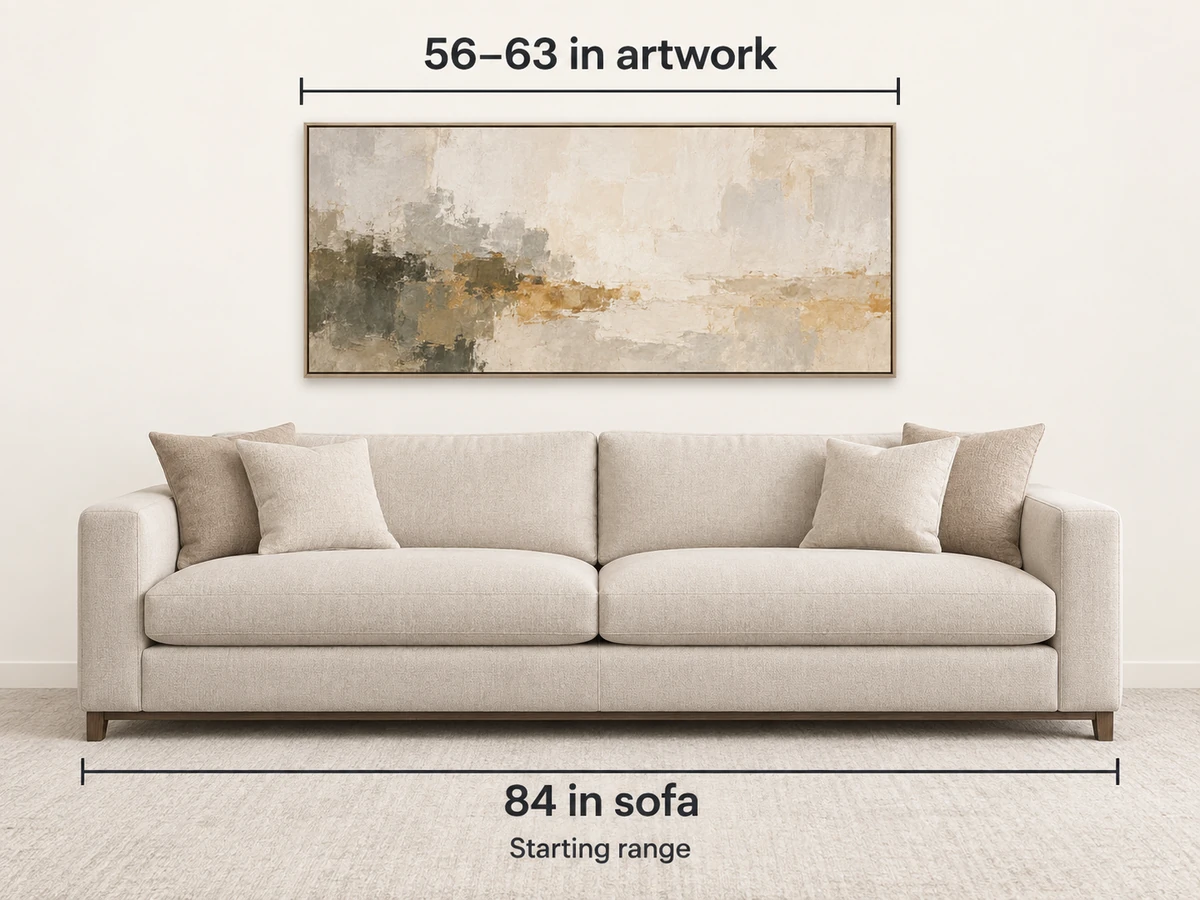
A Practical Furniture-to-Artwork Width Reference
The table below applies the two-thirds to three-quarters guideline to several common furniture widths. Use it as an initial range rather than a required formula.
| Furniture Width | Starting Artwork Width | Approx. Metric Range |
|---|---|---|
| 48 in (122 cm) | 32–36 in | 81–91 cm |
| 60 in (152 cm) | 40–45 in | 102–114 cm |
| 72 in (183 cm) | 48–54 in | 122–137 cm |
| 84 in (213 cm) | 56–63 in | 142–160 cm |
| 96 in (244 cm) | 64–72 in | 163–183 cm |
| 108 in (274 cm) | 72–81 in | 183–206 cm |
If the size you calculate is not offered by the painting you want, the calculation has not failed. Artworks are sold in discrete sizes rather than every possible inch. Compare the nearest available options against the measured wall zone and test both outlines at full scale.
Three Worked Examples Make the Size Rules Easier to Use
Example 1: An oil painting above an 84-inch sofa
Start with the sofa width:
- Sofa width: 84 in (213 cm)
- Two-thirds of 84 in: 56 in
- Three-quarters of 84 in: 63 in
- Starting artwork range: approximately 56–63 in (142–160 cm) wide
If available widths are 55 and 63 inches, both are plausible. The broader option can anchor an open wall; the smaller one leaves more room for curtains, lamps, or shelving.
Example 2: A painting above a 60-inch console
A 60-inch (152 cm) console gives a starting artwork width of approximately 40–45 inches (102–114 cm).
A 40-inch portrait canvas and a 42-inch landscape canvas both fit that range, but the portrait rises higher while the landscape spreads visual weight across the console. Check orientation before choosing.
Example 3: An open 72-inch wall section
Suppose the usable wall zone is 72 inches (183 cm) wide and there is no furniture directly below the artwork.
- 60% of 72 in: 43.2 in
- 75% of 72 in: 54 in
- Starting artwork range: approximately 43–54 in (109–137 cm) wide
A 48-inch painting sits near the middle of that range; a 54-inch piece creates a stronger focal point. A 30-inch canvas leaves much more negative space and should be an intentional choice.
Real Size Examples From the Room Oil Painting Collection
General sizing rules are easier to apply when compared with paintings that are actually available in different formats and size ranges. These examples use current Room Oil Painting listing data rather than hypothetical product dimensions.
Quiet Earth: How a Square Format Uses Wall Space
Product: Quiet Earth – Hand-Painted Wabi-Sabi Abstract Wall Art
Format: Square
Current size options: 60 × 60, 70 × 70, 80 × 80, 90 × 90, 100 × 100, 110 × 110, 120 × 120, 150 × 150, and 160 × 160 cm
Frame options: Unframed, PS Frame, Aluminium Alloy Frame, and Walnut-Finish Frame
View artwork: Quiet Earth
What this example shows: A square painting gains width and height together. Moving from 80 × 80 cm to 120 × 120 cm adds 40 cm in both directions and more than doubles the canvas area. Check vertical clearance as carefully as the side margins.
Chromatic Symphony: Sizing a Horizontal Painting Above Wide Furniture
Product: Chromatic Symphony – Hand-Painted Abstract Oil Painting
Format: Landscape / horizontal
Current size options: 60 × 80, 70 × 100, 80 × 110, 90 × 120, 100 × 135, and 120 × 160 cm
Frame options: Unframed, PS Frame, Aluminium Alloy Frame, and Walnut-Finish Frame
View artwork: Chromatic Symphony
What this example shows: For an 84-inch sofa, the usual starting range is approximately 56–63 inches (142–160 cm). Chromatic Symphony’s current 120 × 160 cm option reaches about 63 inches across in its listed horizontal format, placing it at the upper edge of that range. Compare the full outline on the wall, then confirm the selected size and framed footprint on the product page.
Dawn Glow: Comparing Square Sizes Without Ignoring Height
Product: Dawn Glow – Hand-Painted Square Sunrise Landscape Oil Painting
Format: Square
Current size options: 60 × 60, 70 × 70, 80 × 80, 90 × 90, 100 × 100, 110 × 110, and 120 × 120 cm
Frame options: Unframed, PS Frame, Aluminium Alloy Frame, and Walnut-Finish Frame
View artwork: Dawn Glow
What this example shows: Subject matter does not determine format. Dawn Glow depicts a landscape but is square: 80 × 80 cm is about 31.5 inches per side, while 120 × 120 cm is about 47.2 inches. Compare both outlines with the available wall zone.
Sailing Horizon: Why a Tall Painting Needs a Height Check
Product: Sailing Horizon – Hand-Painted Vertical Sailboat Landscape Oil Painting
Format: Tall portrait / vertical
Current size options: 60 × 120, 70 × 140, 80 × 160, 90 × 180, and 100 × 200 cm
Frame options: Unframed, PS Frame, Aluminium Alloy Frame, and Walnut-Finish Frame
View artwork: Sailing Horizon
What this example shows: A tall painting can fit a narrow wall yet occupy substantial height. The 60 × 120 cm option reaches about 47.2 inches vertically; 100 × 200 cm reaches about 78.7 inches. Measure to the nearest shelf, molding, light, or ceiling detail before choosing.
Choose Square, Portrait, or Landscape Before Fine-Tuning the Size
Two paintings with similar surface areas can behave very differently on the same wall. Orientation changes the direction in which the artwork carries visual weight.
Portrait oil paintings
Portrait artwork is taller than it is wide. It often fits narrow wall sections, entryways, spaces between windows, beside tall cabinetry, or anywhere a horizontal painting would move too close to surrounding architecture.
A portrait format also emphasizes vertical space. That can be useful when the wall is narrow but has generous height.
Square oil paintings
Square artwork creates a compact, centered footprint. It can work well above a smaller console, beside a single chair, on a wall with strong symmetry, or anywhere the available area feels nearly equal in width and height.
Square pieces can also be paired. Two square canvases may provide the horizontal presence a single square painting cannot achieve.
Landscape-format oil paintings
Landscape orientation means the canvas is wider than it is tall. This format naturally follows long horizontal furniture such as a sofa, bed, sideboard, or dining cabinet.
Do not confuse landscape orientation with landscape subject matter. A painting of mountains, countryside, water, or trees can still be a portrait-format painting if the canvas is taller than it is wide. When you are planning wall proportions, use the physical format of the canvas rather than the subject depicted in the painting.
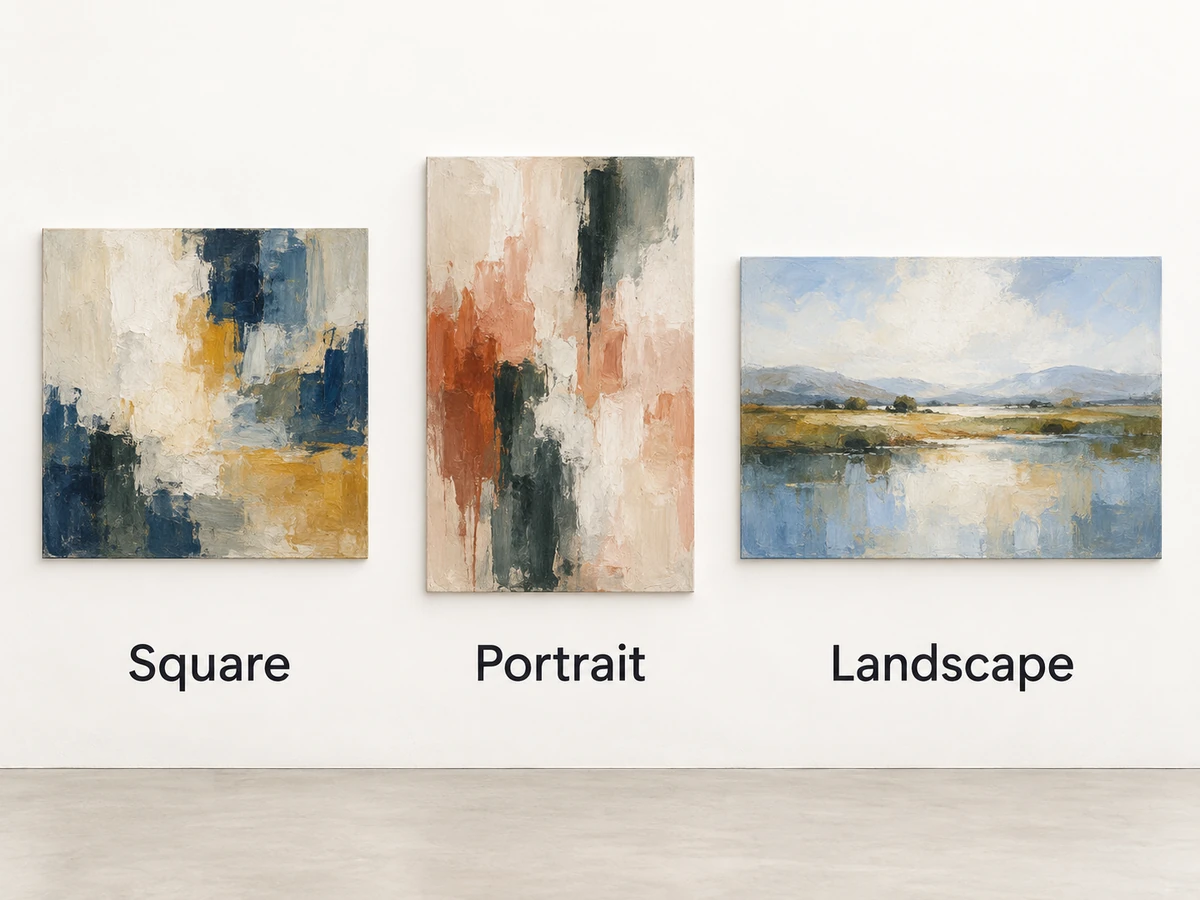
| Format | Often Works Well In | Visual Effect |
|---|---|---|
| Portrait | Narrow walls, entryways, between windows | Emphasizes vertical space |
| Square | Balanced wall zones, consoles, paired layouts | Creates a compact focal point |
| Landscape | Above sofas, beds, sideboards, wide walls | Emphasizes horizontal width |
One Large Painting or Several Smaller Pieces?
The proportion rules apply to the complete visual arrangement, not only to each individual canvas.
If two paintings are displayed together, add the width of both pieces and the gap between them before comparing the arrangement with the furniture or wall.
Two-piece example
Two 24-inch-wide paintings with a 3-inch gap create a total arrangement width of:
24 + 3 + 24 = 51 inches
If the arrangement hangs above a sofa, compare 51 inches with the sofa width—not 24 inches.
Three-piece example
Three 18-inch-wide paintings with two 3-inch gaps create:
18 + 3 + 18 + 3 + 18 = 60 inches
Visually, the wall reads the group as a roughly 60-inch-wide composition.
This is useful when you like smaller paintings but need enough total scale to anchor wide furniture. A diptych, triptych, or carefully spaced pair can occupy a similar visual width to one large painting while creating a different rhythm.
For sizing purposes, calculate the total arrangement width first. Spacing, alignment, and mixed-frame layouts can be planned separately once the overall scale is established.
When a Large Statement Oil Painting Makes Sense
One substantial oil painting can give a broad wall a single, calm focal point. It works best when the ceiling and furniture carry enough visual weight to support the scale.
Large does not mean edge-to-edge. Leave enough space around the canvas to separate it from curtains, doors, cabinets, trim, and nearby decor. If those margins disappear, the usable wall zone is too narrow for that size.
Know When the 60–75% Guideline Should Be Adjusted
Adjust the usual range when the room has one of these conditions:
- Unusually tall ceilings: extra vertical volume can support more visual presence, provided the side margins remain comfortable.
- Asymmetrical architecture: windows, sconces, or shelving can shift the visual center away from the physical midpoint of the wall.
- Narrow vertical walls: clean side margins and a suitable portrait proportion may matter more than filling a target percentage.
- Pairs and sets: compare the total arrangement width, including gaps, with the wall or furniture.
How to Read Oil Painting Dimensions Online
Online size selectors can look straightforward until two stores use different dimension conventions or a frame changes the finished footprint. Read the measurement label before assuming what the numbers mean.
Confirm whether dimensions are width × height
Many art and home-decor listings present dimensions as width × height, but you should not assume every seller uses the same order. Look for an explicit label or diagram.
If a listing clearly uses width × height:
- 60 × 90 cm describes a portrait format.
- 90 × 60 cm describes a landscape format.
- 80 × 80 cm describes a square format.
Those examples describe orientation only. They do not tell you whether the measurement refers to the canvas, the painted image, or the complete framed piece.
Canvas dimensions and finished framed dimensions are not necessarily the same
A size such as 80 × 120 cm—approximately 31.5 × 47.2 inches—may describe the canvas or painted artwork area. If a decorative frame is added, the finished piece may occupy more wall space.
Do not apply a generic allowance such as “add three inches to every side.” Frame profiles differ. Some are narrow and restrained; others create a wider outside footprint.
When the wall is tight, the measurement that matters most is the finished outer dimension.
Before ordering a framed painting: check the individual artwork’s current size and frame information. Do not estimate the finished frame size from a generic rule.
What If Your Ideal Size Falls Between Two Available Options?
A calculation may suggest 52 inches while the painting is offered at 47 and 55 inches. Treat 52 inches as a target zone and compare the real options with the room:
- Choose the larger option when the wall is open, the furniture is substantial, and comfortable margins remain.
- Choose the smaller option when windows, curtains, lighting, or doorways constrain the wall zone.
- For portrait formats, check height as well as width. A small width increase can create a much larger vertical footprint.
- For framed artwork, compare the finished outer size. Then mark both candidate outlines on the wall before deciding.
Test Both Sizes on the Wall Before Ordering
A mathematical range narrows the choices. A full-size wall test tells you how those choices actually behave in the room.
Painter’s tape is a simple way to preview the outer dimensions without buying the artwork first.
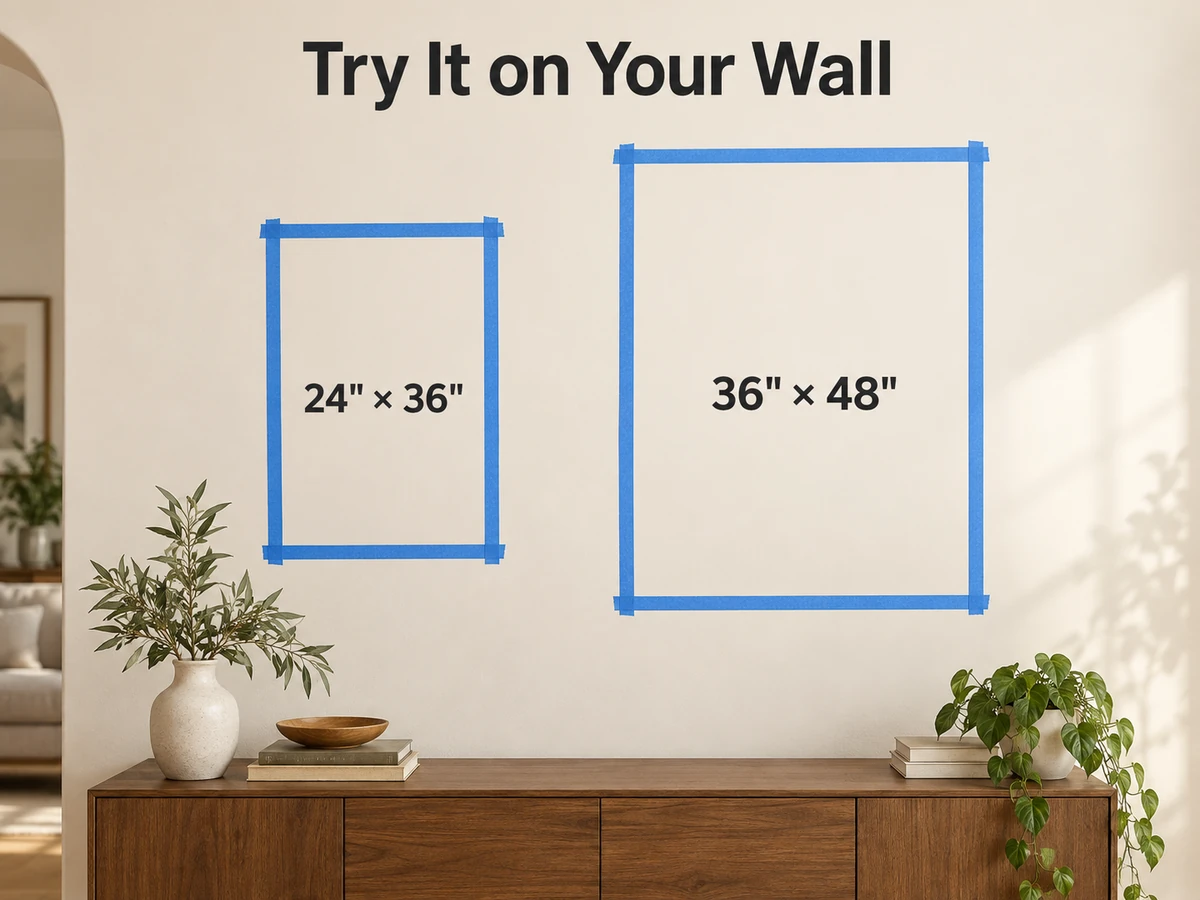
- Choose the first painting size you are considering.
- Convert the width and height into the units you use at home.
- Mark the full rectangle on the wall with low-tack painter’s tape.
- If a frame will increase the finished dimensions, approximate the framed outer footprint when possible.
- Repeat the process for the second size if you are deciding between two options.
- Step away from the wall and compare the outlines from normal viewing positions.
Judge the painting from where you will actually see it
Do not decide while standing two feet from the wall with a tape measure in your hand.
If the painting will hang in a living room, look from the seating area and from the main entrance into the room. For a dining room, look from the table and from the doorway. For an entryway, step back to the position from which you first see the wall when entering the space.
A large outline may feel excessive from close range and entirely appropriate at normal viewing distance. The reverse can happen with small artwork: a canvas that seems substantial in your hands may disappear visually when viewed from across a room.
If you remain uncertain, leave the tape in place for several hours. Seeing the outline during ordinary use of the room often gives a better answer than repeatedly recalculating the same percentages.
Six Oil Painting Sizing Mistakes to Avoid
1. Measuring the whole wall instead of the usable wall
Doors, curtains, lighting, plants, shelving, and furniture can reduce the area that visually belongs to the artwork. Measure the clear wall zone.
2. Choosing artwork that is too small for the furniture below it
A small painting centered over a wide sofa can appear isolated because the artwork does not have enough visual weight to anchor the furniture.
3. Looking at width while ignoring height
This is particularly common with portrait paintings. Two options can have similar widths while producing very different vertical scale.
4. Confusing landscape subject matter with landscape orientation
A mountain or seascape is not automatically a horizontal painting. Use the physical canvas dimensions when deciding whether a piece fits the wall.
5. Forgetting the finished framed dimensions
If the size selector describes the canvas, a decorative frame can increase the outer footprint. This matters most in constrained spaces.
6. Ordering before testing the scale at full size
A painter’s-tape outline takes only a few minutes and can immediately show whether the proposed artwork feels isolated, balanced, or crowded.
Move From the Calculated Size to the Sizes Actually Available
For a narrow or vertically oriented wall, begin by browsing portrait paintings. For a compact or balanced wall zone, explore square paintings. If you are working with a substantial feature wall, compare the large statement artwork currently available.
On the product page, compare each available size with your measurements and confirm how an optional frame affects the outer footprint.
A Final Size Check Before Buying
- You measured the usable wall space.
- You measured the furniture when relevant.
- You chose an orientation that fits the wall zone.
- You checked the current canvas and frame information.
- You compared the actual available sizes.
- You tested the final footprint on the wall.
Oil Painting Size Decision Path
Is the painting going above furniture?
Yes: Measure the furniture width and begin around two-thirds to three-quarters of that width.
No: Measure the usable visual wall zone and begin around 60%–75% of its width.
Is the wall tall and narrow?
Start with portrait formats.
Is the wall broad or positioned over long furniture?
Compare landscape-format artwork.
Is the wall zone visually balanced in width and height?
Square artwork may fit naturally.
Will you add a decorative frame?
Check the finished outer dimensions rather than relying only on the canvas size.
Are you between two available sizes?
Mark both dimensions on the wall and compare them from the normal viewing position.
Oil Painting Size Guide: Frequently Asked Questions
How do I know what size oil painting I need?
Measure the usable wall zone first. For an open wall, roughly 60%–75% of the usable width can be a practical starting range. If the painting will hang above a sofa, bed, console, or sideboard, begin around two-thirds to three-quarters of the furniture width. Then compare the height, orientation, frame dimensions, and surrounding negative space before choosing the final size.
What size painting should go above a sofa?
A useful starting point is artwork roughly two-thirds to three-quarters of the sofa width. For an 84-inch (213 cm) sofa, that produces a range of approximately 56–63 inches (142–160 cm). Nearby curtains, lamps, shelving, windows, and the finished frame size may justify moving toward the smaller or larger end of that range.
What if the painting size I calculate is not available?
Choose the closest available sizes and test both on the wall. The larger option often works better when the wall is open and the furniture is substantial. The smaller option may be more appropriate when windows, curtains, lighting, or architectural features limit the visual wall zone. You do not need to match a calculated target to the exact inch.
Can a painting be too large for a wall?
Yes. Large artwork can feel crowded when it leaves too little negative space or comes too close to windows, curtains, cabinetry, doorways, molding, or neighboring decor. The important measurement is the usable wall zone around the painting rather than only the overall size of the room.
Does the frame count toward the painting size?
The frame counts toward the amount of wall space the finished artwork occupies. However, an online product’s listed dimensions may refer only to the canvas. Check the individual artwork and frame information before assuming the displayed size represents the complete outer dimensions.
Should I choose a square, portrait, or landscape oil painting?
Let the shape of the available wall guide the decision. Portrait paintings are useful on narrow and vertical walls, landscape-format paintings naturally follow sofas and other wide furniture, and square paintings fit balanced wall zones well. Choose the physical canvas orientation independently from the subject depicted in the painting.
Sources & Further Reading
The percentages in this guide are practical design references, not universal standards. Room shape, furniture, frame width, orientation, and intentional negative space can all change the final choice. Product sizes and frame options in the examples were checked against the current Room Oil Painting listings on September 16, 2026.
- Blue Surf Art — Choosing the Right Oil Painting Size for Your Space: A Complete Guide. Supports furniture-to-artwork proportion guidance, room-based considerations, frame allowances, and painter’s-tape mockups.
- ArtVault Studio — Oil Painting Size Guide. Supports comparisons among portrait, landscape, and wider formats, along with metric and imperial size references.
- Paints Lab — Wall Art Size Guide: Find the Perfect Fit for Your Space. Supports wall-measurement and furniture-proportion planning with room-based examples.
- The Worlds Artist — Oil Painting Canvas Size & Format Comparisons. Supports visual comparison of portrait, landscape, panorama, and square canvas formats.
For more practical guidance on choosing, framing, displaying, and caring for artwork, visit the Room Oil Painting Art Guide.