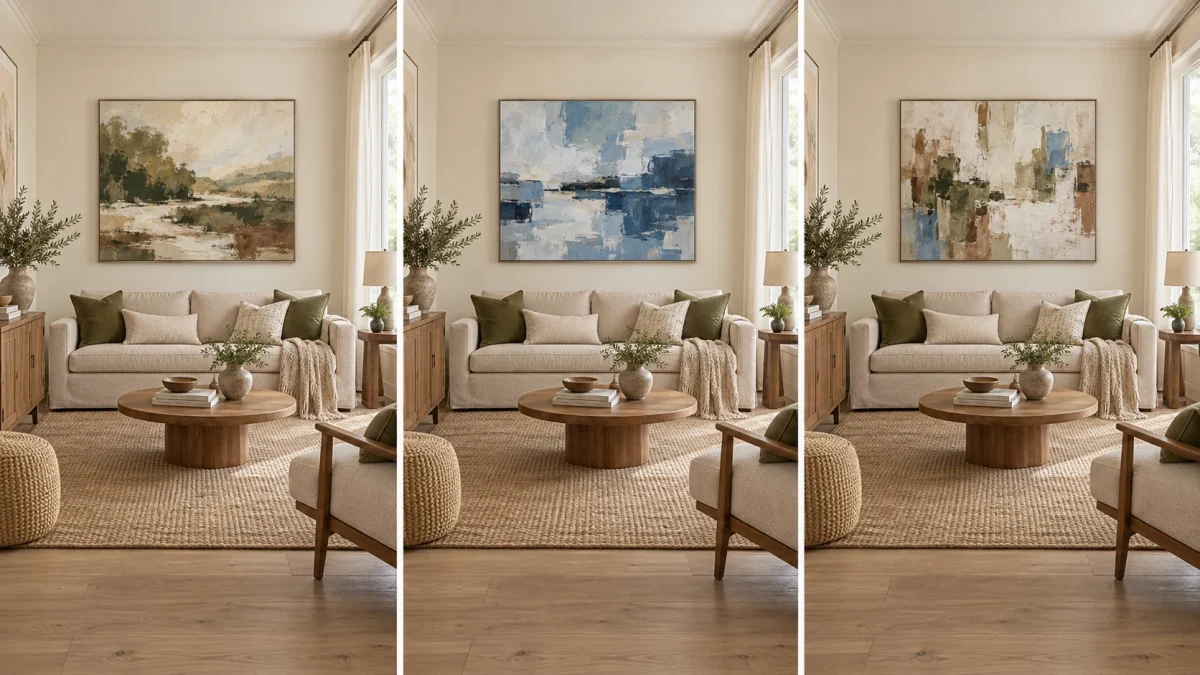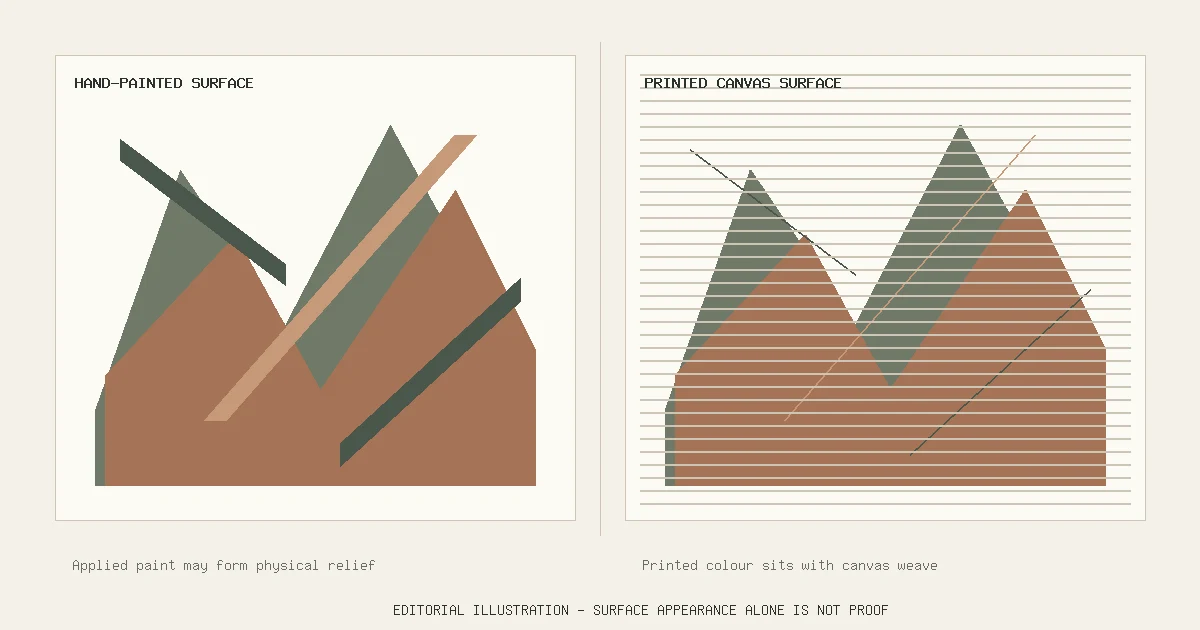
A hand-painted oil painting and a canvas print can carry a similar image, but they are made in fundamentally different ways. In a hand-painted oil painting, paint is physically applied to a prepared support. In a canvas print, an image is reproduced on canvas by a printing process.
That distinction sounds simple until you shop online. Canvas has a weave of its own, coatings can reflect light, and a printed image can receive clear gel or selected strokes of paint after printing. A close-up photograph may show texture without showing where that texture came from. The safest approach is to combine the seller’s wording, material details, surface photographs, edge and back views, and direct answers to specific questions.
Hand-Painted vs. Printed vs. Hand-Embellished
- Image formation
- Oil paint applied to the support
- Surface
- Paint layer over a prepared ground
- Texture source
- Brush, knife and paint handling
- Image formation
- Digital image printed on canvas
- Surface
- Ink plus canvas weave or coating
- Texture source
- Fabric and finish, not painted image formation
- Image formation
- Printed image with hand additions
- Surface
- Ink below selected gel or paint
- Texture source
- Canvas, coating and applied embellishment
What Is a Hand-Painted Oil Painting?
Oil paint is pigment bound in a drying oil. A hand-painted oil painting is made by placing and manipulating that paint on canvas, panel, or another prepared support. Brushes and palette knives can leave directional marks, overlaps, soft transitions, scraped passages, or raised ridges. The finished image exists in those applied paint layers rather than in a printed reproduction below them.
Paint thickness is not fixed. Museum material references document oil paint used in thin applications as well as raised impasto. A painting with restrained, smooth passages can still be hand-painted, while a heavily textured surface is not automatically proof of painting. Look for variation that relates to the image and the described process, then seek supporting views and seller disclosure.
What Is a Canvas Print?
A canvas print reproduces an image onto woven canvas, commonly through digital inkjet printing. It may be stretched over bars, gallery-wrapped, mounted, or framed. The word canvas names the support, not the way the image was made. Both paintings and prints can therefore be “on canvas.”
A print can be a thoughtful, high-quality product. It offers consistent reproduction and can make an image available in several sizes. Printing-industry guidance describes giclée as digital printing, usually inkjet; the term identifies a print process rather than a painting method. What matters for a buyer is accurate naming: a giclée on canvas should be sold as a print, not presented as if the image were formed entirely in oil paint.
What Is a Hand-Embellished Canvas Print?
A hand-embellished canvas print begins with a printed image. After printing, selected areas receive hand-applied material such as clear gel, acrylic paint, oil paint, metallic leaf, or varnish. The treatment may follow visible brushstrokes in the reproduced image or add new highlights. Official publisher documentation for hand-embellished giclées confirms that these additions can create genuine physical relief over the printed base.
This hybrid should be described on its own terms. It is more than an untouched print, yet it is not a fully hand-painted image unless the seller can show that the complete visible image was formed with paint rather than ink. Ask what was printed, what was added by hand, who added it, and how much of the surface was treated.
What’s Actually on the Canvas?
Hand-Painted Oil Painting vs. Canvas Print at a Glance
| Question | Hand-Painted Oil Painting | Canvas Print | Hand-Embellished Canvas Print |
|---|---|---|---|
| How is the image formed? | Paint is applied to the support. | A digital image is printed onto canvas. | An image is printed, then selected material is applied by hand. |
| What is on the surface? | Paint layers over a prepared support. | Ink plus canvas weave and any stated coating. | Ink plus selected gel, paint, leaf, or other stated additions. |
| Brushwork | Can be physically present, from subtle to pronounced. | Visible brushwork may be part of the reproduced image. | Some marks may be physical additions over printed brushwork. |
| Can texture exist? | Yes, but not every oil painting is heavily textured. | Yes: canvas weave and coatings have surface character. | Yes: embellishment can produce real raised relief. |
| Repetition | Repeated compositions may show execution differences. | Prints are designed for repeatable reproduction. | The print repeats; hand additions may vary. |
| Response to angled light | Relief may cast small changing highlights and shadows. | Weave, sheen, and coatings may also reflect. | Applied gel or paint can cast genuine small shadows. |
| Automatically original? | No. Making method does not establish authorship or uniqueness. | No. Ask whether it is an open or limited edition and what it reproduces. | No. Hand finishing does not erase the printed base. |
| What should a buyer verify? | Technique, medium, finished-piece photos, variation, authorship claims. | Print method, substrate, coating, edition status, color and sizing. | Printed base, applied material, coverage, finisher, edition details. |
How to Tell If a Painting Is Hand-Painted or Printed
No single home test settles every object. Use the following checks as a sequence, and treat inconsistent evidence as a reason to ask more questions rather than to make a confident attribution.
1. Read the Making Method First
Start with exact nouns and verbs. “Oil painting on canvas” and “painted by hand” describe a different process from “giclée canvas,” “canvas print,” “reproduction,” “hand-finished,” or “gel embellished.” Vague phrases such as “canvas art,” “oil-paint effect,” or “museum style” do not identify how the image was formed. Save the listing wording and ask the seller to resolve any conflict between title, specification table, and description.
2. Use Angled Light
Light from a low angle can reveal physical relief. Raised paint may produce small highlights on one side of a ridge and shadows on the other, and those effects change as the light or viewpoint moves. This is useful evidence, not proof. Canvas weave, gloss coating, textured varnish, and clear gel can also catch light. Ask for an unfiltered video or several stills taken from different angles rather than relying on one dramatic close-up.
3. Compare Several Areas of the Surface
Inspect quiet backgrounds as well as prominent strokes. In a fully painted work, physical marks may change with the handling of forms, edges, and transitions. On an embellished print, raised material may appear only over selected highlights while broad areas retain a consistent printed base. That pattern can suggest a hybrid process, but it still needs confirmation from the seller.
4. Look at Macro Details
Close views can reveal whether color boundaries are built from material or reproduced as tiny regular marks. Some printing methods show dots under magnification, but modern inkjet output may not present an obvious pattern in an ordinary phone photo. Compression, sharpening, and screen pixels can also mislead. A macro image should support, not replace, written production details.
5. Inspect the Edges and Back
Edges can show whether an image wraps as a print, whether paint continues around a canvas, and how the support is stretched. The back may show labels, edition information, maker marks, or construction details. None is decisive alone: paintings can have neat machine-stretched supports, prints can receive paint on their edges, and framing can hide the reverse. Use these views to check whether the object matches the listing.
6. Ask the Seller Direct Questions
- Is the complete visible image formed with applied paint, or is any part printed?
- If it is embellished, what material is added and to which areas?
- Are the photographs of the exact finished piece, a representative finished piece, or a digital room visualization?
- Who designed the image, who executed the surface, and are those claims documented?
- Is the work unique, made in repeated hand-painted versions, or part of a print edition?
6 Checks Before You Buy
- Read the listing
- Inspect surface photos
- Check angled light
- Compare macro details
- Check edge / back evidence
- Ask the seller
YesYou have stronger evidence.
No / unclearAsk before buying.
Does a Hand-Painted Oil Painting Always Have Heavy Texture?
No. Oil paint can be brushed in thin layers, blended smoothly, glazed, scumbled, or laid down in thick impasto. Museum references document both paint standing in relief and very thin oil applications. A smooth-looking passage does not disqualify a painting, and a raised passage does not prove that the entire image was painted.
Canvas weave creates its own regular relief. A glossy finish can produce highlights without deep texture. Clear gel can be brushed over a printed image to imitate the direction of depicted strokes, and hand-embellished prints can carry actual paint. Read the surface together with the construction statement.
Hand-Painted Does Not Automatically Mean One-of-a-Kind Original
These terms answer different questions. Hand-painted describes a making method. Original concerns the creative and authorship context: who conceived and made the work, and whether it is the work represented by the claim. One-of-a-kind addresses uniqueness. Signed only reports the presence of a signature; it does not authenticate the object by itself. Provenance is the documented history of an object’s creation and ownership.
A studio can paint the same composition more than once. Each execution may be hand-painted without being the sole version of that design. A hand-painted reproduction can use real oil paint while reproducing another artwork. A signature can be applied, printed, copied, or unrelated to the person assumed by a buyer. If originality, named authorship, or provenance matters, request specific documentation rather than inferring those qualities from texture.
What a Good Online Product Page Should Show
- A direct technique statement: fully hand-painted, printed, or printed and hand-embellished.
- The medium and support, separated clearly: for example, oil paint on canvas or pigment ink on canvas.
- A straight-on image plus useful surface, edge, and reverse views when those details are available.
- Clear labeling for lifestyle visualizations, room mockups, representative images, and exact-piece photographs.
- Whether repeated pieces may vary and whether the image belongs to an open edition, limited edition, or unique work.
- Only supportable authorship, signature, material, and provenance claims.
A page does not need to overwhelm the buyer with technical language. It does need to make the production category unmistakable. If the title says “oil painting” while the details say “giclée,” ask the seller which statement describes the physical item that will ship.
A Real Room Oil Painting Example
The current Garden Flourish product page identifies the item as a hand-painted botanical oil painting on canvas. Its current product data lists the technique as “Hand-Painted,” the material as “Oil Canvas,” and the surface character as “Painted Surface.” Those fields support the store’s production-method claim. They do not establish a named artist, an artist signature, one-of-a-kind status, provenance, or museum-grade materials, and this guide does not add those claims.
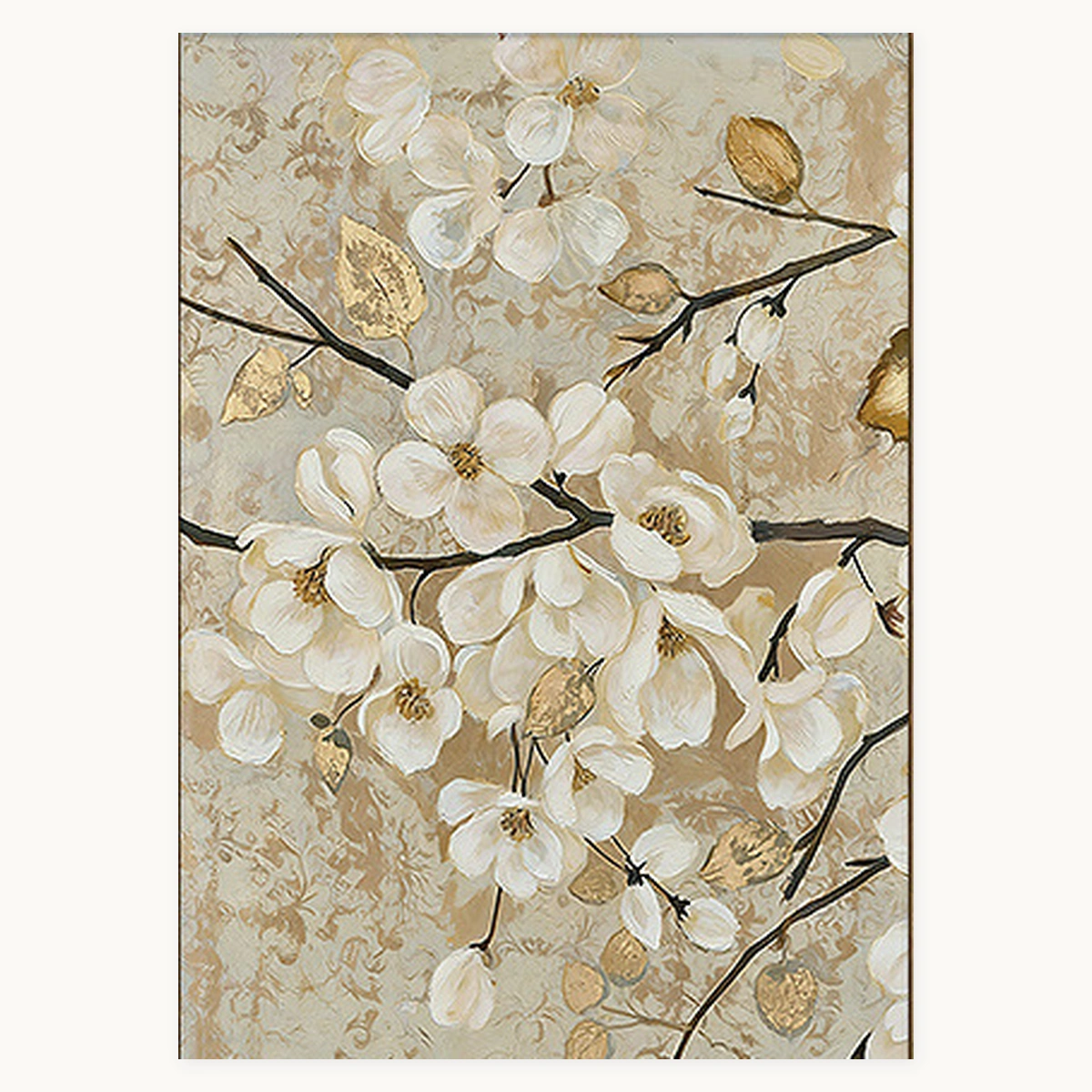
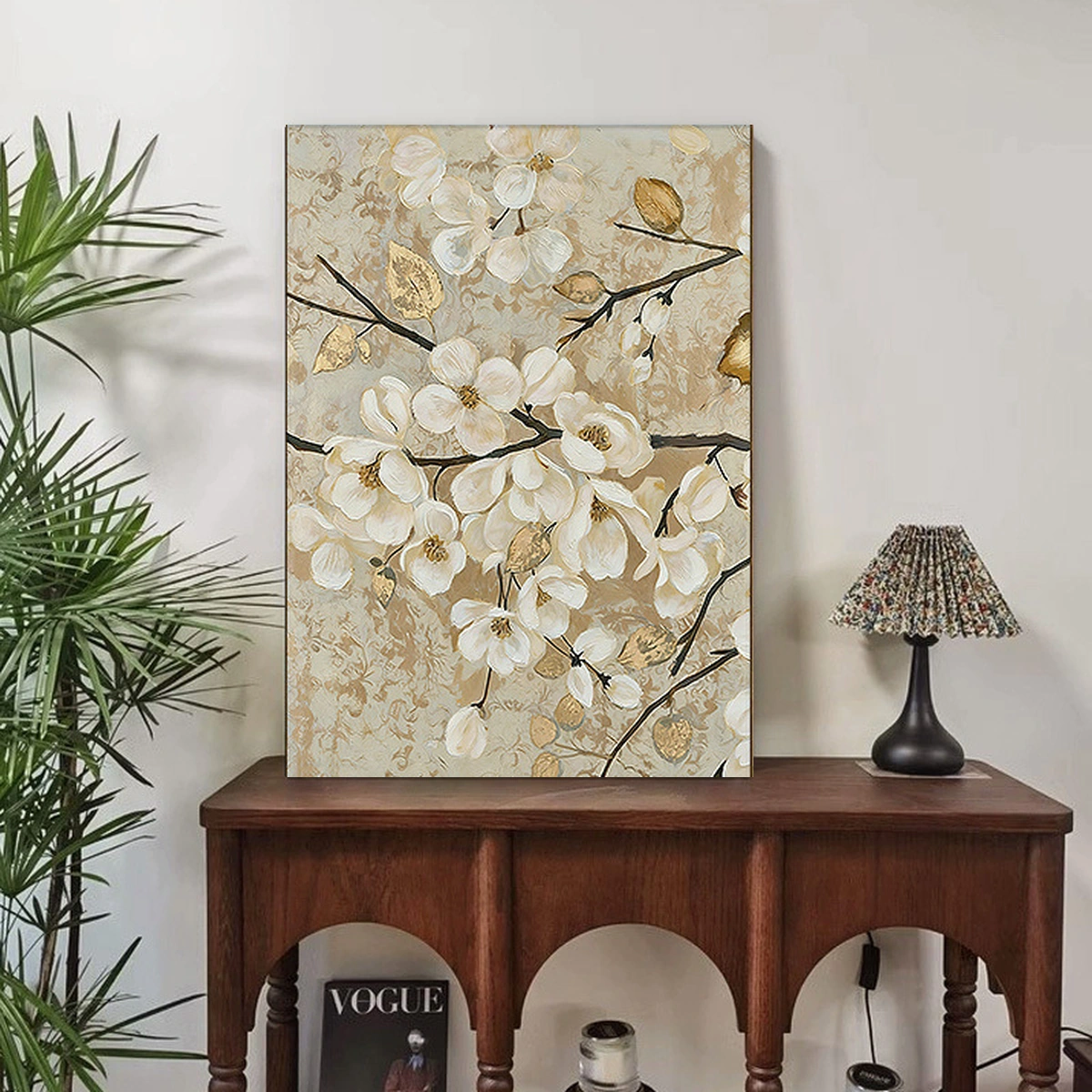
This example also shows why image roles matter. A straight-on image helps a buyer assess the composition. A room scene helps with mood and approximate proportion. Neither replaces a close surface view, an edge or back image, or a clear written answer when a buyer needs stronger verification.
Which Is Better for Your Home?
Choose a Hand-Painted Work When…
You want applied paint to be part of the object, you value small execution differences, and you are comfortable checking how the seller defines authorship and repetition. The reason to choose it should be the surface and making process you expect, not a blanket assumption about investment value.
Choose a Canvas Print When…
You want a consistent reproduction, need access to a particular image or size, or prefer a clearly disclosed printed format. A well-described print is not a failed painting; it is a different product. Check print method, substrate, coating, color expectations, and edition information where applicable.
Consider a Hand-Embellished Print When…
You want a printed image with selected physical accents and accept that the base image remains a reproduction. Verify what is added, whether the displayed texture represents the delivered piece, and whether the person applying the embellishment is identified.
After choosing the production category, use How to Choose the Right Oil Painting Size for Your Wall to plan scale, and compare presentation options in Framed vs. Unframed Oil Paintings.
Common Buying Mistakes
- Assuming canvas means painting. Canvas is a support. Ink and paint can both be placed on it.
- Assuming texture means fully hand-painted. Weave, gel, varnish, and selective embellishment can all create physical effects.
- Assuming giclée means painting. Giclée is a digital printing term. It may describe excellent printing, but it still describes a print process.
- Assuming hand-painted means one-of-a-kind. A composition can be painted repeatedly, reproduced by a studio, or painted from another source image.
- Assuming a lifestyle image proves the physical product. Room scenes may be digital visualizations. Look for labels and separate finished-piece evidence.
- Using price as authentication. Price can reflect size, framing, labor, branding, or retail strategy. It does not prove production method or provenance.
A Simple Buying Decision
First decide what you expect the object to be: fully painted, printed, or printed and embellished. Then check whether the listing uses one category consistently across the title, materials, details, images, and seller response. If physical paint matters, ask for an angled-light surface view and an explicit statement that no part of the image is printed. If repeatable color and accessible sizing matter more, a clearly disclosed canvas print may fit better. If you like surface accents but accept a printed base, compare hand-embellished options.
Pause when the language shifts between categories, the surface photographs are missing, or the seller will not answer direct construction questions. You can continue through the site’s broader Art Guide or browse the shop, but evaluate each listing on its own evidence.
Frequently Asked Questions
What is the difference between an oil painting and a canvas print?
In an oil painting, applied oil paint forms the visible image. In a canvas print, ink reproduces an image on canvas. Both can use canvas, so the support alone does not identify the process.
How can you tell if a painting is hand-painted?
Combine the listing’s technique statement with angled-light images, varied surface details, edges, the reverse, and direct seller answers. Raised texture is helpful evidence only when it agrees with the rest of the information.
Can a canvas print have texture?
Yes. Canvas weave is already textured, coatings can add sheen, and gel or paint can create raised relief. A hand-embellished print may have genuine physical marks over a printed base.
Is canvas art the same as an oil painting?
No. “Canvas art” names a broad category. It can include oil or acrylic paintings, inkjet prints, photographs on canvas, and embellished prints.
What is a hand-embellished canvas print?
It is a printed canvas that receives selected hand-applied material after printing. The additions may be paint, gel, leaf, or another medium, while the underlying image remains printed.
Is giclée the same as hand-painted?
No. Giclée refers to digital printing, usually inkjet. A giclée can later be hand-embellished, but that does not make the complete underlying image hand-painted.
Is every hand-painted oil painting an original?
No. Hand-painted describes execution. Originality, authorship, uniqueness, signature, and provenance are separate claims that require their own evidence.
Is an embellished canvas print fake?
No, provided it is accurately described. It is a legitimate hybrid format. The problem is not embellishment; it is presenting a partly printed object as if its complete image were formed by paint.
References
- Getty Research Institute — Art & Architecture Thesaurus: Oil Paint
- Getty — What Is Impasto?
- Fine Art Trade Guild — Print Info & Advice
- Disney Fine Art — Giclée and Hand-Embellishment Information
Editorial note: Adrian Bellamy writes Room Oil Painting’s practical guides on choosing, displaying, framing and caring for artwork. This guide combines museum material references, printing documentation, original diagrams and a read-only review of the cited Room Oil Painting listing. It does not authenticate individual artworks or replace professional appraisal.